

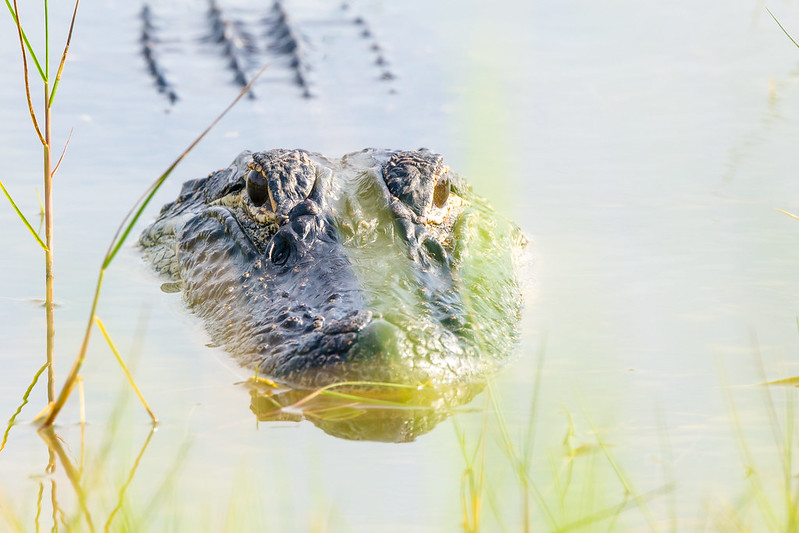
Central Florida’s waterways turned deadly after three people were attacked by alligators in a single week, including an Orlando woman who died after a massive gator mauled her in a state forest river.
The week of attacks began at Rainbow River in Marion County, where FWC details cited by FOX Weather described a man being injured after contact with an alligator.
The man was later released from the hospital, and an eight-foot-plus alligator was removed from the area.
The next bite involved a child at Nelson Fish Camp, where a shoreline fishing trip ended with an alligator injury to the hand.
The June 27 report also ended with officials trapping another alligator measuring more than eight feet.
The deadliest case came a day later near the Barr Street Trailhead, where Orlando resident Brittany Clark was attacked in the Econlockhatchee River.
State wildlife officers, Seminole County deputies and a contracted trapper converged on Little Big Econ State Forest after the mauling.
🎓Support Defending Education’s mission to expose political agendas in America’s classrooms and restore quality education for all! 🎓 Help protect students and strengthen education nationwide ➡️➡️➡️ DONATE TODAY!!! 🇺🇸
Clark was transported as a trauma alert but did not survive the trip to the hospital.
Her death capped a terrifying seven-day stretch that had already included two other Central Florida alligator bites.
The horror of the attack emerged in 911 audio, with Clark’s boyfriend pleading for help as bystanders described catastrophic injuries.
The 911 call grew more horrifying when Clark’s boyfriend reported that “both her arms, both her arms are off,” and another woman described one limb as “hanging by a thread.”
When the dispatcher asked about Clark’s other arm, the woman answered, “Gone.”
Clark’s boyfriend tried to convey the severity of the attack, calling it “bad, real bad” as he begged responders to hurry.
“Please hurry… she’s losing a lot of…” he said before trailing off.
Multiple agencies moved into the river area as the investigation unfolded.
“Multiple agencies and a contracted nuisance alligator trapper have responded to the scene,” FWC spokesperson Chad Sklute stated.
A “very large 13-foot alligator” was later “harvested” from the attack area, officials revealed.
Officials also removed an 11-footer nearby while warning that mating season can make dangerous gators “very territorial.”
The same week, another predator attack horrified vacationers in Mexico, where a California couple raced toward the surf to help a man being dragged by a crocodile.
The rescue attempt began during Jamie Yetter and Chris Bury’s family vacation at the Marriott Puerto Vallarta Resort and Spa, after screams sent them rushing toward the water.
At first, the scene looked to them like a rip-current rescue.
Then they realized the man in the water was being dragged away by a massive crocodile.
In his Fox News account, Bury described the first moments as confusion over what was happening.
“We were at the pool when we heard some screams down at the water … We thought he was just stuck in the rip current,” Bury recalled.
Their swimming experience made them think they could help — until the danger became clear.
The rescue shifted from familiar to terrifying when warnings about a crocodile reached Bury in the water.
“I saw that [the victim] was kind of struggling,” he explained. “There was … no one around that could help save him.”
The victim was identified as Irving, a 28-year-old Mexican man who had gone to the resort city with friends.
A life preserver failed when Irving, apparently in shock, could not reach it.
A kayak became the only available rescue option, even though it came without paddles.
In an NBC4 interview, Bury described how little rescue equipment was available.
‘There were no oars. There was really nothing at the beach at all to help,’ Bury stated.
“I laid on my stomach and paddled with my hands to get out there,” he added.
‘We were just scrambling, trying to do what we could,’ Bury recalled. ‘I was on the kayak right when he got pulled under.’
Yetter described the crocodile as enormous as it clamped onto Irving’s thigh.
‘The size of this crocodile, I mean, his head was as long as my torso, his tail thicker than my legs. He was just turning him, taking him under,’ she recalled.
“Every time the man would resurface, [he] was deeper and deeper into the ocean,” she added.
The rescue attempt ended in front of stunned beachgoers, with Irving killed before anyone could pull him from the water.
His body was recovered about 12 hours later, early Saturday morning.
In comments to Surfer Magazine, Yetter faulted the resort’s beach warnings after the attack.
‘They didn’t tell anyone it was dangerous,’ she argued.
The signs she noticed warned about smaller marine dangers, not the crocodile threat she later described.
‘They didn’t tell us we shouldn’t go swimming. Even the next morning, I went down to the ocean. I assumed the beach would be closed,’ Yetter said.
Even the next morning, she said, the shoreline had not been closed.
‘The beach wasn’t closed. There were no no-swimming signs,’ Yetter argued.
Police were said to have captured the crocodile after the fatal attack.